
Is it a duplexer or diplexer that I need to work satellites with one full duplex dual band radio?
Radio chatter
Ok. I think I just answered my own question by actually reading the article the following quote is sourced from. I'm going to post this just in case others have the same question.
TL;DR: Duplexer is the answer.
Diplexers separate signals based on frequency, whereas duplexers separate the transmit and receive path of signals based on their direction.
Source: https://resources.pcb.cadence.com/blog/2023-diplexers-vs-duplexers
The Venn diagram in the above source really brings it home. "Duplexers separate the transmit and receive path of signals based on direction"
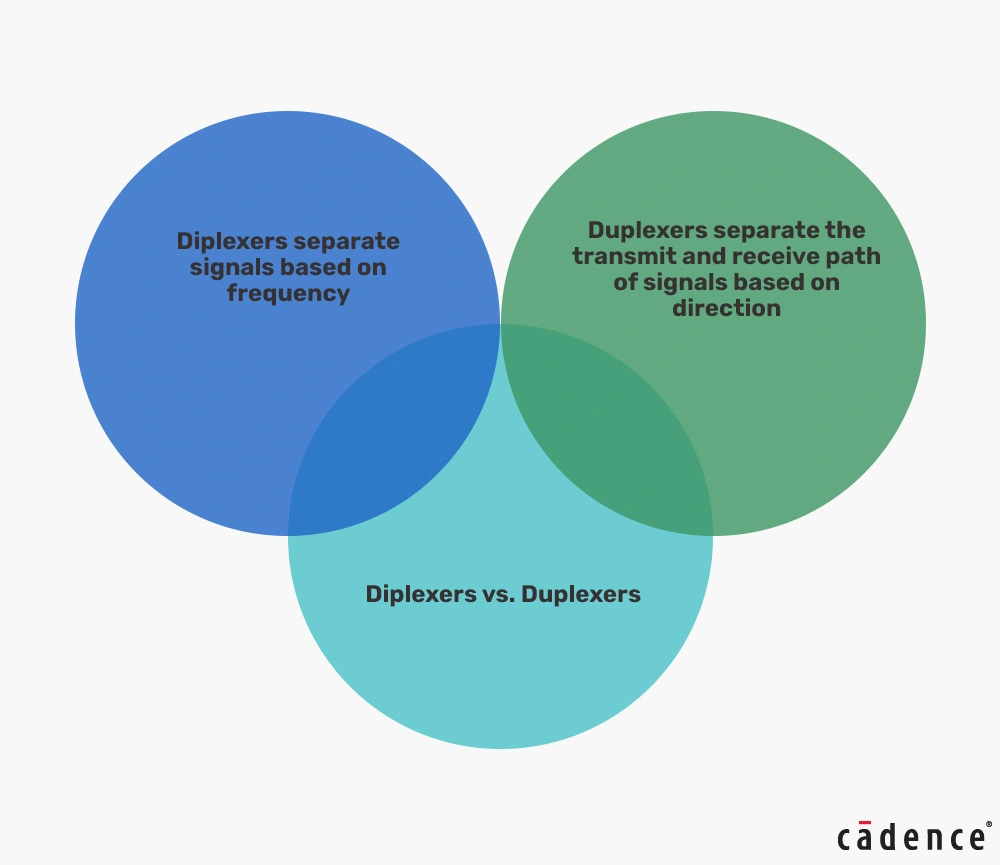
My confusion started as I was googling around and found this Reddit thread: https://www.reddit.com/r/amateurradio/comments/eq7tal/do_i_need_a_duplexer_for_satellite_work_with_a/ with answers in both directions.
OP asked "Do I need a duplexer for satellite work with a full duplex radio?"
Answers included:
"devices meant […] specifically for separating HF and VHF/UHF"
As the terminology is commonly used, that is a diplexer, not a duplexer.
Then another support for diplexer:
A duplexer (the english speaking world) is a device to combine or split RF paths for a specific frequency, generally in the same band and traditionally use cavity filtering to accomplish this. A diplexer is a device to combine or split frequency ranges of different bands and typically uses a LC filters. The designs come in arrangements of low pass/high pass (diplexer), low pass/band pass/high pass (triplexer), and various low pass/band pass/band pass/…/high pass designs (multiplexers).
The reason you see duplexer often (mistakenly) used in place of diplexer…has to due with the lack of the specific word in the language used in the country the product was manufactured in.
Then the contradiction:
Yes. You need a duplexer to send 70cm to the 70cm side and 2M to 2M.
Along with a link to build duplexers: http://k0lee.com/duplexer.php
And finally, a suggestion to buy a diplexer.
You need a diplexer. Get an MFJ-916.
But the MFJ-916 isn't a diplexer. It's a duplexer. https://mfjenterprises.com/products/mfj-916b
I feel like many people are misusing these terms.
Update: A comment I received:
What you're seeing is just people (and companies!) using the two words to mean the same thing.
Everything that you see for sale in the ham space under $200 is a "separate signals based on frequency" device and nothing is a "separate the transmit and receive path of signals based on their direction" device, unless you are looking at $1000+ repeater gear.
Source: https://www.reddit.com/r/amateurradio/comments/1bwk0sn/is_it_a_duplexer_or_diplexer_that_i_need_to_work/ky6o767/
In a separate comment the commenter just referred to it as a d*plexer. Maybe that is the term we should use as another person summed it up nicely with “The important thing is to look at the specs to ensure you have the isolation you need.“